MBR, MBBR and A²/O rank among the most widely‑adopted biological wastewater‑treatment processes globally. They differ substantially in technical principles, treatment mechanisms and suitable application scenarios. Many project clients ask: “What exactly sets these three processes apart? How do I pick the right one?”
Written from a practical engineering perspective, this article outlines their core distinctions to help you quickly identify the optimal technical route for your project.
1. MBR: High‑efficiency Biochemical Process Driven by Membrane Separation
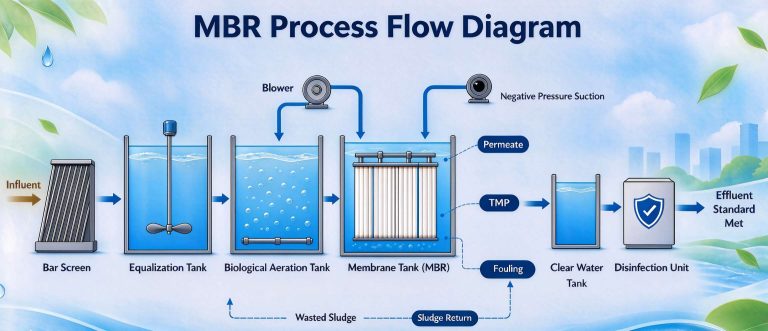
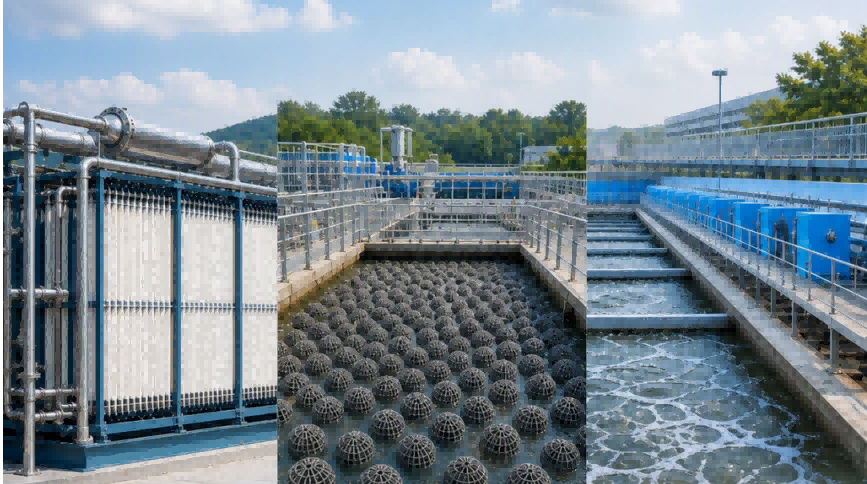
MBR (Membrane‑Bio‑Reactor) integrates membrane separation with biochemical reactions. Its defining feature: membrane modules replace secondary clarifiers to accomplish solid‑liquid separation.
Advantages of MBR
- Superior effluent quality: Near‑zero suspended solids (SS), extremely low turbidity. Well‑suited for water reuse and plant upgrading projectsThe World ….
- Compact footprint: No secondary clarifier required, resulting in smaller tank structures.
- Strong shock‑load resistance: MLSS can reach 8000‑12000 mg/L.
- High automation level: Stable membrane‑module performance supports intelligent system management.
Typical MBR Applications
‑ Municipal wastewater‑treatment plant upgrading
‑ Hospitals, schools and commercial complexes
‑ Water reuse inside industrial parks
‑ High‑standard discharge (Class‑1‑A, reclaimed‑water production)
Core value of MBR: Premium effluent quality, compact layout and easy capacity expansion.
2. MBBR: Cost‑effective Process Boosting Biochemical Performance via Biofilm Carriers
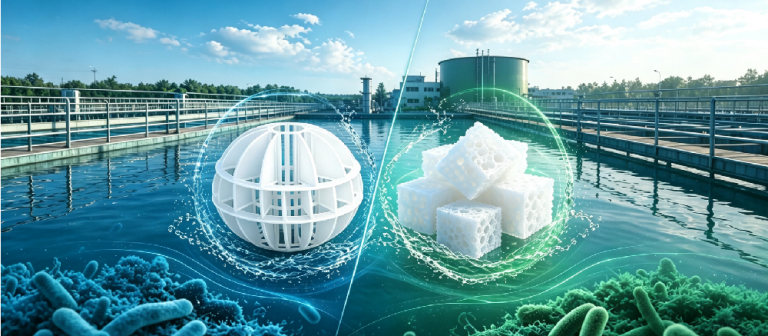
MBBR (Moving‑Bed Biofilm Reactor) is a biochemical technology utilising suspended bio‑media and attached biofilm growth. Its core feature: large quantities of bio‑media raise the effective biomass inside reaction tanks.
Advantages of MBBR
- Low retrofitting cost: Treatment capacity can be improved simply by adding bio‑media into existing tankage.
- Stable operation: Attached biofilm offers strong shock‑load tolerance.
- Simplified management: No sludge‑recirculation system is needed.
- Handles high‑strength wastewater: robust removal performance for COD and ammonia‑nitrogen.
Typical MBBR Applications
‑ Capacity expansion for ageing wastewater‑treatment plants
‑ Pre‑treatment for industrial wastewater
‑ High‑strength organic wastewater
‑ Loading‑capacity enhancement for existing biological systems
Core value of MBBR: Cost‑effective capacity increase, ideal for retrofit projects.
3. A²/O: Proven Mature Process for Nitrogen & Phosphorus Removal
A²/O (Anaerobic‑Anoxic‑Oxic) is the classic industry‑standard nutrient‑removal wastewater‑treatment process. Its core principle: sequential anaerobic‑anoxic‑oxic phases achieve biological nitrogen and phosphorus elimination.
Advantages of A²/O
‑ Proven, reliable technology: Widely deployed in municipal wastewater‑treatment facilities.
‑ Low operating expenditure: No membrane modules, moderate energy consumption.
‑ Suitable for large‑scale plants: Handles high flow rates with straightforward process layout.
‑ Compatible with hybrid configurations: Can be combined with MBR or MBBR (A²/O + MBR; A²/O + MBBR).
Typical A²/O Applications
‑ Municipal wastewater‑treatment plants
‑ Centralised‑treatment facilities for industrial parks
‑ Large‑flow wastewater‑treatment projects
Core value of A²/O: Stable performance, cost‑efficiency for large‑volume treatment.
Core Comparison: MBR / MBBR / A²/O
Below is an engineering‑oriented comparison of key performance metrics:
| Process | Core Mechanism | Effluent Quality | Footprint | Capital Cost | Operating Cost | Typical Application Scenarios |
|---|---|---|---|---|---|---|
| MBR | Membrane separation + biochemistry | ★★★★★ (Highest) | ★★★★ (Compact) | ★★★★ (Relatively high) | ★★★ (Moderate) | Upgrading, water reuse, hospitals, commercial facilities |
| MBBR | Bio‑media attached biofilm | ★★★ (Moderate) | ★★★ (Medium) | ★★ (Low) | ★★ (Low) | Retrofits, industrial wastewater, loading enhancement |
| A²/O | Anaerobic‑Anoxic‑Oxic sequence | ★★★★ (Consistent stable output) | ★★ (Relatively large) | ★★ (Low) | ★★ (Low) | Municipal WWTPs, large‑flow projects |
Practical Decision‑making Guidance
Prioritise high‑quality effluent → Choose MBR
Best for hospitals, schools, commercial complexes, water‑reuse schemes and plant‑upgrade projects.
Want to boost treatment capacity on a limited budget → Choose MBBR
Best for expansion of old wastewater‑treatment plants, industrial‑wastewater pre‑treatment and high‑strength effluent streams.
Large‑flow projects with conventional discharge standards → Choose A²/O
Best for municipal wastewater‑treatment plants and centralised park‑scale treatment.
Common hybrid‑process combinations:
‑ A²/O + MBR (for stringent discharge limits) ‑ A²/O + MBBR (low‑cost performance upgrading) ‑ MBBR + MBR (advanced industrial‑wastewater polishing)
Summary
None of these three processes is universally “best”. The correct choice depends entirely on project‑specific requirements.
‑ MBR: Premium water quality, compact footprint; for upgrading & water‑reuse applications ‑ MBBR: Low‑cost capacity expansion, good shock resistance; optimised for retrofits
– A²/O: Mature, economical and dependable; for large‑volume treatment