When engineers first get to know the MBBR process, one common question arises:
Why does wastewater‑treatment performance improve significantly after adding bio‑media into the reactor tank?
Fresh bio‑media is normally white, yet gradually turns yellow‑brown or even dark‑brown after running for a period of time.
The core secret behind this observation is:
The bio‑media itself does not treat wastewater. Treatment is completed by the biofilm attached onto the media surface.
This article explains one of the most critical steps in MBBR operation: how biofilm forms on MBBR carrier media.
1. What is Biofilm Colonization?
Think of each piece of MBBR bio‑media as a small apartment building, and microorganisms as the residents living inside.
Wastewater flowing through the reactor naturally carries abundant microorganisms. These microbes keep making contact with bio‑media surfaces.
As large quantities of microorganisms gather on the outer surface and internal pores of carriers, a stable biofilm layer develops — this whole process is known as biofilm colonization.
Once colonization succeeds, massive populations of microorganisms anchored on media continuously break down organic pollutants, ammonia‑nitrogen and other contaminants to purify wastewater.
Simply put: bio‑media acts only as a carrier; microorganisms are the real treatment workforce.
2. Why Biofilm Colonization Is Essential for MBBR
Many people mistakenly believe bio‑media alone delivers treatment performance in MBBR systems. This is not accurate.
The primary function of bio‑media is to provide stable living habitats for microorganisms. Thanks to porous geometry and large specific surface area, carriers support dense microbial growth.
After biofilm establishment, microbial concentrations per unit volume greatly exceed those found in conventional activated‑sludge systems. This accounts for MBBR’s well‑known strengths: high volumetric loading, strong shock‑load resistance and compact footprint.
In short: Without biofilm colonization, carriers are merely plastic or sponge materials. Only after successful colonization do they gain real wastewater‑treatment capacity.
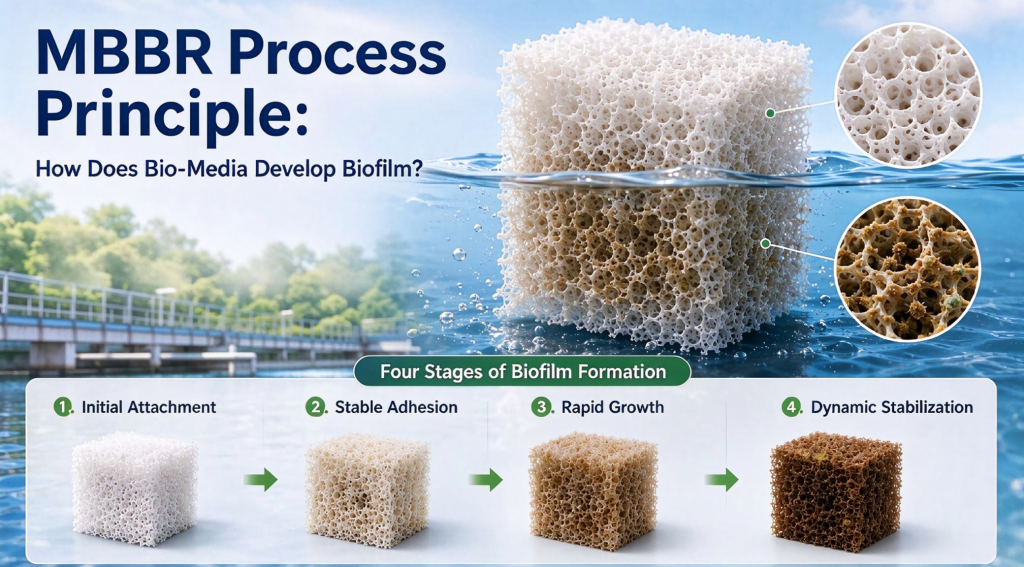
3. Four Key Stages of MBBR Biofilm Formation
Stage 1: Initial Microbial Attachment
New bio‑media surfaces are clean upon installation. Microorganisms carried by flowing wastewater come into contact with carrier surfaces, and some microbes temporarily adhere.
Attachment remains weak at this phase. Many attached microbes can easily slough off under aeration or hydraulic shear force. Visually there is barely any noticeable change; carriers stay predominantly white.
Stage 2: Stable Microbial Adhesion
Over time, more microorganisms accumulate on carrier surfaces. Microbes secrete sticky extracellular polymeric substances (EPS), acting like natural biological glue.
This adhesive layer anchors microorganisms firmly onto bio‑media and prevents wash‑out. Biofilm colonization officially commences. Carrier colour slowly shifts from pure white to pale yellow.
Stage 3: Rapid Biofilm Growth
With sufficient nutrients and dissolved oxygen available, microorganisms multiply rapidly. Biofilm thickness keeps increasing as microbial populations expand, and carrier colour deepens further from pale yellow to yellow‑brown.
Pollutant removal efficiency rises markedly during this stage, with measurable improvements in COD and ammonia‑nitrogen reduction.
Stage 4: Mature and Steady‑state Biofilm
Biofilm will not keep thickening indefinitely. Once it reaches an optimal thickness, the outer layer keeps growing while inner layers gradually age.
Aged biofilm detaches naturally, and new microorganisms attach and reproduce continuously. The whole system reaches dynamic equilibrium.
Carriers typically appear yellow‑brown to dark‑brown at this phase, representing the most stable and high‑performance operating condition for MBBR reactors.
4. Qualities of Bio‑Media That Accelerate Biofilm Colonization
Not all materials support favourable microbial growth. High‑performance MBBR carriers achieve fast colonization thanks to these key characteristics:
1). Abundant Porous Structure
Take polyurethane sponge bio‑media as an example. Its internal 3D interconnected pores act like countless micro‑habitats ideal for microbial colonisation.
2). Large Specific Surface Area
Larger available surface area provides more attachment sites, sustaining higher total biomass, which underpins MBBR’s high‑efficiency treatment capability.
3). Good Hydrophilicity
Microorganisms thrive in aquatic environments. Hydrophilic material surfaces attract microbes more readily and promote stable biofilm build‑up.
4). Strong Hydraulic‑shock Resistance
Bio‑media circulates and churns continuously inside aerated tanks. Well‑engineered physical structure enhances mass‑transfer efficiency while protecting biofilm from large‑scale sloughing.
5. Main Factors Affecting Biofilm Colonization Speed
In practical projects, the rate of biofilm formation is governed by these variables:
1). Water Temperature
Microorganisms are temperature‑sensitive, much like living creatures. ‑ Fast colonization occurs at 25℃ ~ 35℃ ‑ Colonization slows down significantly below 15℃ ‑ Longer start‑up periods are normally required in winter conditions
2). Dissolved Oxygen
Dissolved oxygen is vital for aerobic microbial reproduction. Insufficient DO slows microbial growth and impairs subsequent treatment outcomes.
3). Organic Loading
Organic contaminants in wastewater serve as food sources for microbes. Too low organic concentration restricts microbial reproduction; excessive loading causes overly‑thick biofilm and potential sloughing.
4). Seed Sludge Inoculation
Adding mature activated sludge during commissioning introduces large microbial populations upfront and substantially shortens colonization cycles. This represents the most widely‑adopted start‑up strategy in field projects.
6. Practical Indicators to Confirm Successful Biofilm Colonization
Field engineers evaluate colonization maturity through three practical approaches:
1). Visual Colour Observation
New bio‑media is normally white. Colour transition sequence after colonization: White → Pale Yellow → Yellow‑Brown → Dark‑Brown. Darker colour generally indicates higher attached biomass loading.
2). Treatment Performance Monitoring (most direct indicator)
Signs of functioning mature biofilm include: ‑ Sustained COD reduction ‑ Improved ammonia‑nitrogen removal efficiency ‑ Stabilised effluent water quality
3). Microscopic Inspection
Observing abundant populations of bacteria, vorticella, rotifers and other microorganisms under a microscope confirms a well‑established and mature biofilm ecosystem.
Conclusion
Many project stakeholders mistakenly regard bio‑media as the core of MBBR technology. In reality, bio‑media is only a growth carrier. Treatment performance ultimately depends on biofilm developed on carrier surfaces.
The whole process — from initial microbial attachment through to steady‑state mature biofilm — essentially builds a miniature self‑sustaining ecosystem.
Understanding biofilm colonization principles explains why MBBR delivers high loading capacity, shock‑resistance and easy capacity expansion.
For real‑world wastewater projects, focus less on whether bio‑media floats and more on biofilm health. Contaminants are removed not by inert carrier material itself, but by billions of microorganisms living upon it.