MBR (Membrane Bioreactor) combines biological degradation with membrane filtration for wastewater treatment. Unlike conventional activated‑sludge systems that rely on secondary clarifiers for solid‑liquid separation, MBR uses membranes to achieve direct phase separation. It delivers consistently low‑turbidity effluent suitable for further polishing or direct water reuse applications.
The core to understanding MBR lies in answering one key question: how exactly does the membrane operate?
1. Basic Configuration of an MBR System
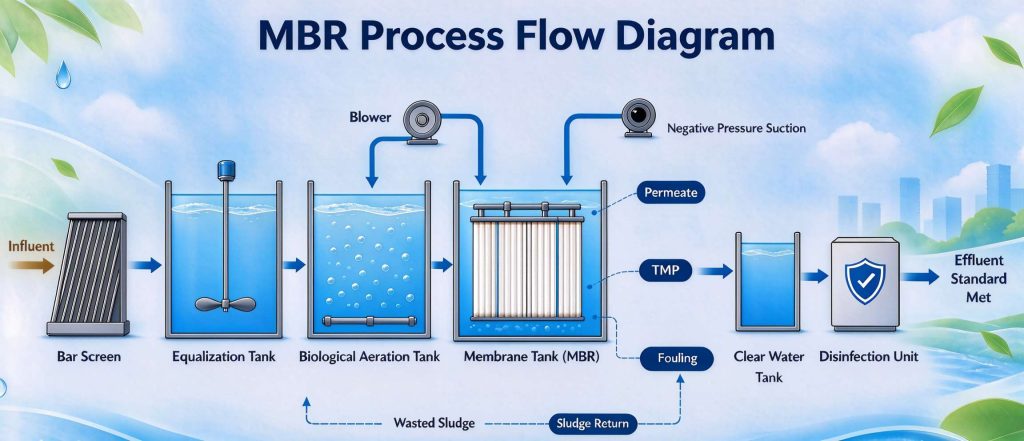
A typical submerged MBR setup consists of three primary functional units:
Biological Aeration Tank: Microorganisms break down organic pollutants under elevated MLSS (Mixed Liquor Suspended Solids) concentrations.
Membrane Tank (Membrane‑Module Zone): Submerged membrane modules are immersed inside mixed liquor; clean permeate is extracted by negative‑pressure suction.
Backwashing & Chemical‑Cleaning System: Controls membrane fouling and stabilises sustainable membrane flux.
2. Core Membrane Function: Solid‑Liquid Separation
Membrane modules form an effective physical barrier for MBR processes:
‑ Nominal membrane pore size ranges from 0.04–0.1 μm
‑ Suspended solids, bacteria and partial viruses are retained on the feed‑side surface
‑ Only water and soluble dissolved substances pass through pores toward the permeate side
3. How Membrane Filtration Takes Place
3.1 Negative‑Pressure Suction
Membrane modules are surrounded by mixed liquor on the outer feed side, with clean‑water permeate channels on the inner side. The system draws water across membrane pores under mild negative pressure (typically ‑10 ~ ‑50 kPa).
3.2 Air Scouring
Continuous aeration beneath membrane modules generates rising bubbles that scour the membrane surface. Key purposes:
‑ Minimise sludge cake accumulation on membrane surfaces
‑ Slow down progressive membrane fouling
‑ Maintain stable operational membrane flux
3.3 Particle Retention & Phase Separation
Membrane pores are significantly smaller than suspended solids, bacteria and most colloidal particles.
‑ Total retention of suspended solids
‑ Complete blockage against bacterial passage
‑ Extremely low‑turbidity permeate qualified for water‑reuse scenarios
4. Critical Operational Challenge: Membrane Fouling & Flux Management
Membrane fouling represents the main operational concern for MBR installations. Two primary fouling categories are recognised:
Reversible Fouling: Surface sludge cake build‑up, recoverable via physical measures such as air scouring or periodic backwashing.
Irreversible Fouling: Internal pore clogging, which requires chemical cleaning with reagents including sodium hypochlorite or citric acid for performance restoration.
5. Key Performance Comparison: MBR versus Conventional Activated‑Sludge Process
| Item | MBR | Conventional Activated‑Sludge Process |
|---|---|---|
| Solid‑liquid Separation | Membrane filtration | Secondary‑clarifier gravitational settling |
| Effluent Turbidity | <1 NTU | 3‑10 NTU |
| MLSS Concentration | 8,000‑15,000 mg/L | 2,000‑4,000 mg/L |
| Footprint | Compact | Large |
| Effluent Stability | Excellent | Subject to sludge‑settling characteristics |
Thanks to these performance advantages, MBR finds broad application in water‑reuse projects, industrial‑wastewater upgrading and municipal‑plant retrofitting.
Conclusion
The strength of MBR technology does not stem merely from advanced membrane material itself. Its true value comes from replacing secondary sedimentation tanks with membrane separation, delivering far more stable and controllable solid‑liquid separation.
Grasping membrane working mechanisms supports better equipment selection, daily operational management and technical communication across wastewater projects.