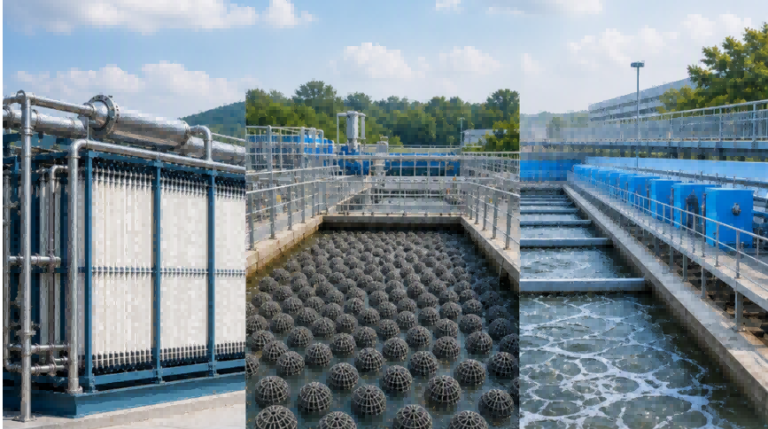
Anyone working in wastewater treatment knows the bioreactor forms the heart of the whole treatment plant.
Yet many projects encounter recurring operational headaches after months or years of service:
‑ Persistently high COD levels
‑ Repeated ammonia‑nitrogen exceedances
‑ Steadily rising electricity bills
‑ Poor treatment performance despite heavy microbial dosing
Operators commonly suspect these root causes first:
‑ Microbial population failure
‑ Sludge ageing
‑ Variations in incoming wastewater quality
These are all plausible explanations. However, one critical factor is frequently overlooked in real‑world projects:
The aeration system is not performing as intended.
Quite simply, reduced bioreactor efficiency often stems not from poor microbial activity, but from insufficient oxygen supply.
1. Microorganisms Inside Bioreactors Also Need to “Breathe”
Most people understand microbes degrade wastewater contaminants, yet few consider what sustains these organisms.
The answer is oxygen.
In nearly all aerobic biological systems, microorganisms carry out two core processes simultaneously: consuming wastewater pollutants for nutrition and using oxygen to support their metabolic functions.
If we compare microbes to factory workers, pollutants represent raw materials, and oxygen acts as electrical power. No amount of raw material will keep production running without reliable power.
Therefore, the primary mission of the aeration system is to deliver a continuous supply of oxygen to microbial communities.
2. Aeration Is More Than Just Blowing Air Into the Tank
Non‑specialists often simplify aeration: start the blower, produce bubbles in the tank, and the job is complete. In practice, aeration systems fulfil two essential roles.
1). Oxygen Supply for Microbes
This is its fundamental function. Oxygen must dissolve into water before microbes can utilise it. Sufficient dissolved‑oxygen levels enable microorganisms to break down COD, ammonia‑nitrogen and other contaminants efficiently.
2). Maintaining Sludge Circulation
Airflow generated by aeration drives hydraulic circulation throughout the tank. This delivers multiple practical benefits:
‑ Prevents sludge sedimentation
‑ Eliminates dead zones inside the reactor
‑ Promotes uniform oxygen distribution
‑ Maximises contact between wastewater and microbial biomass
In short, the aeration system functions both as an oxygen‑supply unit and the hydraulic driving force of the bioreactor.
3. Why Ammonia‑Nitrogen Often Fails To Meet Discharge Limits
Field engineers frequently observe this scenario: COD complies with standards, yet ammonia‑nitrogen remains unstable. Aeration performance should be the first point of inspection.
Organic‑matter degradation and ammonia‑nitrification have distinctly different oxygen requirements. Heterotrophic bacteria responsible for COD removal show relatively low sensitivity to oxygen fluctuations.
By contrast, nitrifying bacteria that convert ammonia‑nitrogen are well‑known high‑oxygen consumers. Even minor dissolved‑oxygen shortages sharply reduce their processing capacity.
This explains the common site condition: acceptable COD removal alongside persistently elevated ammonia‑nitrogen concentrations. The issue is rarely an absence of nitrifying bacteria; rather, nitrifiers suffer from oxygen deprivation.
4. More Aeration Does Not Equal Better Treatment
At this point, one might assume higher aeration output always yields improved results. This is a widespread industry misconception.
Once dissolved‑oxygen satisfies microbial demand, further increasing aeration brings negligible performance improvement while introducing new operational problems:
‑ Higher power consumption & increased blower energy cost
‑ Excessive hydraulic shear stress damaging activated sludge flocs
‑ Escalated overall operational expenditure
To draw a simple analogy: eating one bowl of rice satisfies hunger; consuming ten additional bowls provides no extra benefit. Oxygen works the same principle: supply only what is necessary.
5. Identical Airflow, Divergent Treatment Outcomes
It is not uncommon to observe two systems with similar blowers and matching airflow rates delivering completely different treatment results.
The key distinction: blowers deliver atmospheric air, but microorganisms require dissolved oxygen.
Not all oxygen introduced into the tank dissolves in water; a large fraction escapes directly to atmosphere. Only dissolved oxygen becomes biologically available.
This brings us to the vital industry metric:
Oxygen Transfer Efficiency (OTE).
Conceptually, OTE quantifies what percentage of injected oxygen actually gets utilised by microbial communities. Higher OTE means superior aeration efficiency; low OTE translates directly into substantial wasted electricity.
6. Why Fine‑Bubble Diffusers Are Widely Adopted
The core principle is straightforward: smaller bubbles dissolve more readily in water.
Imagine comparing melting rates between one large block of ice versus an equal‑weight pile of crushed ice. Crushed ice melts far faster due to greater total contact surface area.
The same logic applies to aeration. Fine‑bubble diffusers generate tiny bubbles that maximise air‑water interfacial area and deliver higher oxygen‑transfer efficiency. This is why fine‑bubble diffuser upgrades represent a popular retrofitting option for many municipal and industrial wastewater plants.
7. Uneven Aeration Poses Greater Risk Than Insufficient Aeration
Field experience shows adequate total airflow does not guarantee good performance. Poor aeration distribution can still undermine system output.
Typical symptoms include vigorous bubbling on one side of the tank and almost no aeration on the opposite side. Zones of over‑aeration co‑exist alongside chronically oxygen‑starved regions within one single bioreactor.
This creates two drastically different micro‑environments inside one tank, dragging down overall treatment performance.
When evaluating aeration‑system quality, look beyond total airflow capacity and prioritise aeration uniformity.
8. Rising Power Bills May Not Originate From Blower Degradation
Many facilities report climbing electricity costs after several years of operation despite relatively stable wastewater throughput. Operators frequently suspect blower wear‑and‑tear.
In numerous real‑world instances, the root cause lies within the diffuser assembly. Over extended runtime:
‑ Micropores become clogged
‑ Diffuser membranes degrade
‑ Pipeline scaling builds up
‑ System aeration resistance rises progressively
Blowers consume extra power just to maintain original design airflow volume. Consequently, treating the same wastewater volume incurs significantly higher energy expenditure.
Effective aeration‑system management requires not only proper operation but also routine preventive maintenance.
Conclusion
Plant personnel often focus heavily on microbial formulations, chemical additives and complex operational parameters. These factors are undoubtedly important.
Nevertheless, one truth is often overlooked for aerobic biological wastewater systems:
Even the most robust microbial communities cannot function without adequate oxygen.
Insufficient oxygen inhibits microbial activity; excessive aeration wastes energy; uneven aeration cripples overall reactor performance.
In many respects, the aeration system acts as the bioreactor’s oxygen supply hub. Stable oxygen delivery sustains healthy microbes, and stable microbes deliver consistent effluent quality.
Whenever bioreactor efficiency declines, evaluate your aeration system first. All too often, treatment performance depends less on how powerful your microbial culture is, and more on whether oxygen reliably reaches every corner of the tank where it is needed.